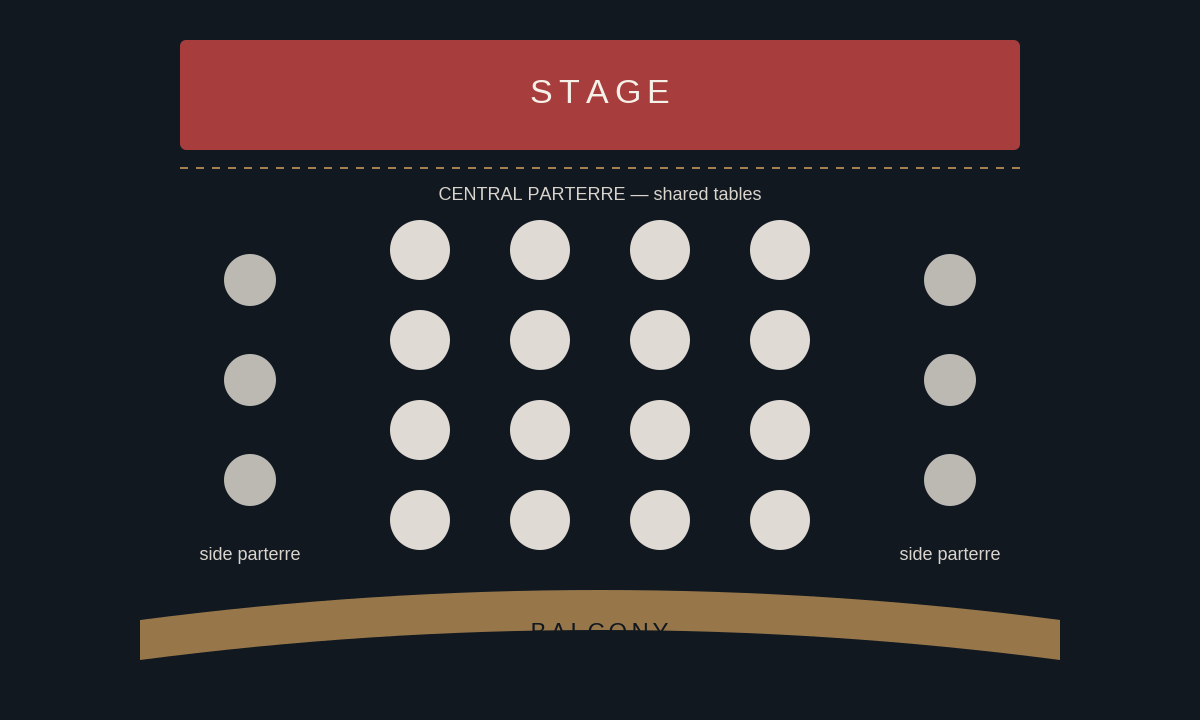
The auditorium is built like a grand dining room facing a stage rather than a conventional theatre. Rows of small shared tables fill the main floor — the parterre — with balcony positions wrapping above. Where you sit changes the angle of the spectacle, not its scale: the production is designed to fill the whole room.
01 The parterre: centre of the room
The parterre floor carries the bulk of seats, arranged around small round or oval tables. Central parterre looks straight down the stage; side parterre angles in from the wings. What defines the experience:
- Proximity. Performers work the stage and the space above it; parterre tables sit inside that volume.
- Sharing. Tables seat several parties together — expect neighbours, and expect the table's small talk to be part of the evening.
- Orientation. Some seats face partially away and guests turn chairs at curtain. Normal practice — the staff choreograph it.
02 The balcony: the wide view
Above and behind the parterre, balcony seating looks down on the full stage picture. The trade is distance for composition: formation choreography, lighting design and the sheer geometry of the revue read best from elevation. Visitors who care about seeing the entire stage — and those more comfortable slightly removed from the room's press — often prefer it.
03 Sightlines, honestly
| Zone | What you see best | The compromise |
|---|---|---|
| Central parterre | Front-on spectacle, performer proximity | Head-height table neighbours; premium pricing |
| Side parterre | Angled stage views, still close | Off-axis for symmetrical tableaux |
| Balcony | The whole picture at once | Distance; less of the room's electricity |
There are no truly bad sightlines — the show is built for a full-volume auditorium — but there are different shows per zone: intimate up close, architectural from above.
04 The shared-table system
Seats are allocated by the house at your service; parties are combined at tables. Practical consequences:
- Exact seats are assigned on arrival rather than picked off a chart at booking.
- Category buys a zone, not a specific table.
- Solo travellers and couples fill table gaps — a feature of the format since the room's earliest decades.
05 Which to choose
Central parterre for maximum immersion and occasions. Side parterre for proximity at gentler pricing. Balcony for composition, comfort with height, and the cheapest entry to the same show. If photography mattered to the choice it does not — photos inside are prohibited either way; see practical rules.